
You are here: Home > Chess for Kids

Learning to play chess is one of the most rewarding things a child can discover.

Chess is fun and exciting, offering wonderful opportunities to grow a child's self respect and build valuable social skills. Encouraging kids to study the game of chess is a great move you can make as a parent. Kids that are mentally gifted as well as children with lesser abilities and those that struggle in school will all benefit from the challenging game.

Chess levels the playing field and allows every child an opportunity to succeed. With encouragement from parents and coaches, children will catch the spirit and eagerly embrace this game, desiring to excel and looking forward to chess competitions.

Chess will not only help a child in school, it will help them in life! As a child learns and studies chess, he or she will be exercising and creating disciplines of the mind while expanding mathematical and calculative abilities. The child will also be learning patience, planning, consequences, balance of time, resources and other essential life skills.

Chess is Fun!

Let's not forget though, chess is fun!! Kids have a blast playing their friends, siblings, and schoolmates. Experience your first chess tournament and you will see that chess teaches a lot, and is a great opportunity for children to socialize, compete, and challenge themselves.

How to Learn Chess

Some children love to read and are very easy to teach. You just hand them a book, and let them absorb it. In most cases however, kids are visual, have a short attention span, and need to be encouraged. It's best to select materials that are not overwhelming, that will be visually appealing, and at a suitable level - especially if you will be letting your child learn on their own.

If you have a quality teacher or chess coach in your area, you may want to take advantage of this, but there's every reason to learn at home, with the great tools available.

Get a basic, but good quality regulation plastic chess set. This will be useful whether you only play at home, or if you are part of a class or club.

Next, choose a combination of DVD instruction, books, and software as you see fit for your child's needs and learning style.

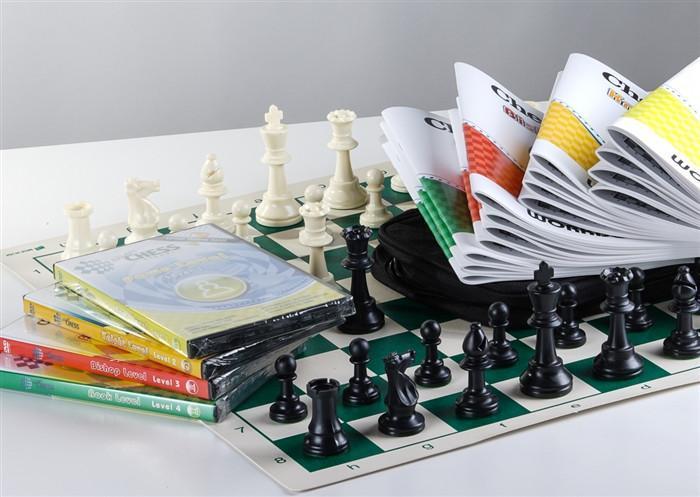
Home Chess Learning Kit
Encourage your child to discover more potential with encouraging, friendly, no nonsense, life-skills based chess teaching, that even 5 years olds can follow. The "Kit" enables parents who want to invest in their child's future, to spend their resources wisely on smart, painstakingly developed chess learning material, that invests in the much needed minds of our young generation.
Fun for the Family
The whole family will love the delightful chess movie Knights of the South Bronx. Remember Searching for Bobby Fischer? If you've watched that one, you'll enjoy this one too. These, plus more great chess gifts for the family are right here.
Sets and Equipment
Here are the chess sets and equipment most suitable for young chess players.
Books for Kids
For kids aged 6 to 12 we recommend three basic and inexpensive chess books: 1) Chess Rules for Students, 2) Checkmate Ideas for Students, and 3) Chess Tactics for Students. The first one explains all the rules and chess notation, the second delves into checkmating patterns, and the third explains and challenges with important chess tactics.
Chess Software
For young kids ages 4 and up, the Fritz and Chesster software teaches chess in a fun way. For kids that are 7 or older and showing a serious interest in chess, the TASC Chess Tutorial (see video), lacks the snazz, but offers a lot more extensive value, with over 2600 interactive positions, introductions to each concept, testing by making the correct move in a position, and scoring. It is a smart investment.
Electronic Chess Sets
A chess computer gives your child "someone" to play when you're just too busy with the housework. It always knows legal moves too, so kids will always learn correct, legal moves. It's a good way to practice what they've already learned, and any computer can play at multiple levels to grow with their experience level.
Sort By:
Page of 1  
Home Chess Learning Kit
Now: $49.95 In Stock!

Everything you need to enjoy chess at home. Not available in retail stores, these exclusive, specialized learning tools are carefully designed to create an enjoyable chess learning experience. Ideal for both kids and adults.
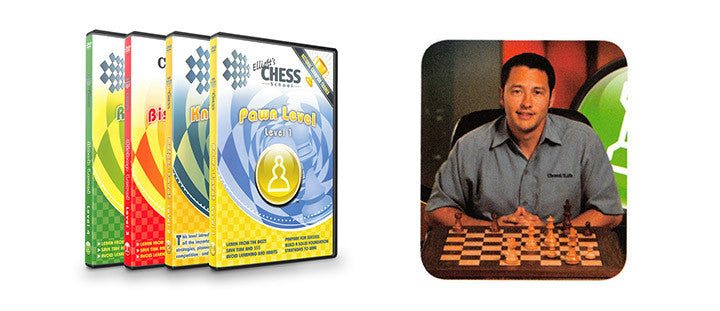
Elliott's Chess School DVD 1, Pawn Level
Now: $29.95 In Stock!

Produce by coach of US Chess SuperNationals winning team and founder of Chess4Life. Simply the best results in chess instruction on DVD for beginners of any age. Exclusive, effective teaching curriculum, which is part of the Chess4Life.com school chess instruction programs. Bonus booklet with practice positions for every topic helps the learner practice and master the material presented. 100% money back guarantee on the entire series or any DVD.
Chess School Pawn Level Workbook
Chess School - Pawn Level Workbook
Now: $9.95 In Stock!

The Pawn workbook applies knowledge learned from the Chess School Pawn Level DVD. It's recommended to get this workbook if you have Elliott's Chess School - Pawn Level DVD
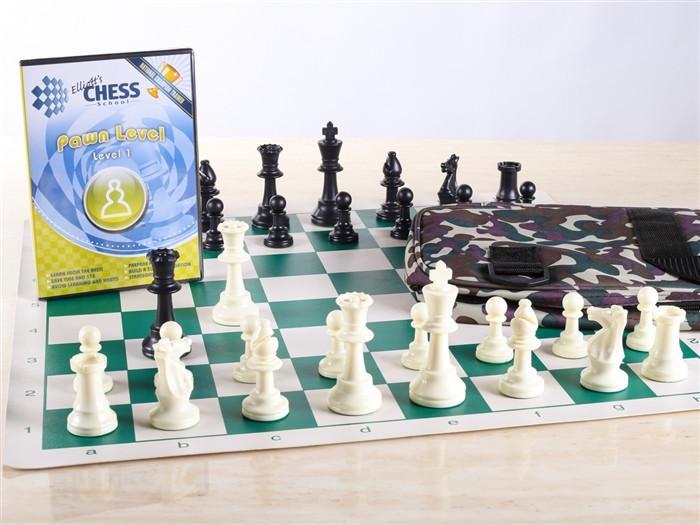
Quality Tournament Chess Set Combo
Quality Regulation Tournament Chess Set Combo
Now: $19.95 In Stock!

This official, regulation combo chess set  is just waiting to enter the grasp of your determined little chess player's hands as he or she studies, challenges buddies, and sometimes competes in the tournament hall with hundreds of other kids. Yeah, it's a ridiculous amount of fun. Don't feel left out though! This same chess set rules the chess clubs today and is for more than youngsters. It's perfect for club players of ALL ages.
Chess Rules for Students - Bain
Now: $3.25 In Stock!

Instruction workbook designed for students just learning the game of chess and for beginning students returning to the game after an absence. Parents unfamiliar with chess will find this booklet a valuable guide
Quality Starter Chess Set
Quality Regulation Chess Set Combo
Now: $12.95 In Stock!

The Regulation Chess Set & Bag comes with our Quality Club Chess Pieces, Vinyl Rollup Chess board, and Chess Bag w/Handle. These chess sets are great for schools, clubs, or individuals who want the convenience of carrying chess sets without needing the larger Carryall Tournament Chess Bag.
Elliott's Chess School DVD 2, Knight Level
Now: $39.95 In Stock!

Elliott's Chess School is compromised of 6 main levels - Pawn, Knight, Bishop, Rook, Queen, and King levels, which if mastered will easily launch a player into the top 5% of scholastic tournament players in the US!
Checkmate - Ideas for Students - Bain
Now: $3.50 In Stock!

An instructional workbook designed for beginning students.
Chess Tactics for Students - Bain
Now: $13.95 In Stock!

A one-of-a-kind instructional workbook designed to help beginners acquire the skills of strong intermediate players.
Chess Tactics
Chess Tactics for Scholastic Players - Ippolito
Now: $17.95 In Stock!

This workbook is based on lesson plans and is a great tool for the player looking to improve and for teachers and coaches!
TASC Chess CD 2
TASC Chess Tutorial 2 (CD) Chess Rules & Learn to Play Chess
Now: $19.95 In Stock!

Beginners will learn to play chess and learn the chess rules, tactics, strategies, and openings clearly with this top rated chess tutorial.
Fritz & Chesster (CD)
Fritz & Chesster, Part 1 (CD)
Now: $39.95 In Stock!

Fritz & Chesster is great for kids ages 5 and up. It will engage youngsters and teach chess in a fun and exciting way!
Fritz & Chesster Learn to Play, Part 2
Fritz & Chesster, Part 2 (CD)
Now: $39.95 In Stock!

Keep the attention of kids with an effective chess learning program that other parents and chess teachers actually recommend. If you want to stay away from rote learning and reading you need this program! It's actually fun for kids while helping them learn chess.
Fritz & Chesster Learn to Play, Part 3
Fritz & Chesster, Part 3 (CD)
Now: $34.95 In Stock!

Part three of the famous chess game Learn to Play Chess with Fritz & Chesster. Powered by Fritz, the world's leading chess software. Developed together with experienced children's chess coaches.  For ages 8 and up.
Chess Tactics for Beginners (CD)
Now: $29.95 In Stock!

More than 1,300 solving positions for beginners!
Chess Wristband
Chess Wristband
Now: $1.99 In Stock!

Kids proudly display their love and enthusiasm for chess with these cool "PLAY CHESS" and "CHECKMATE" wristbands! They're a fun way to show your support for chess and reward your young chess achievers with a wristband they'll love!
Chess is Cool Wristband
Now: $1.99 In Stock!

Here's a cool way to show that you play chess! Kids proudly display their love and enthusiasm for chess with these  "CHESS IS COOL" wristbands! Reward young chess achievers with a wristband they'll love! Inside of the chess wristband is all chessboard pattern. It's a great chess gift for kids.
How to Beat Your Dad at Chess - Chandler
Now: $13.46 In Stock!

How to Beat Your Dad at Chess makes improving easy and fun, and is full of helpful explanations and practical advice on how to approach chess games with confidence and success.
Chess Tactics for Kids - Chandler
Now: $13.46 In Stock!

Chess enthusiasts of all ages and levels will find this book an instructive delight. In a simple, easy-to-understand format it explains how to bamboozle your chess opponents using commonly occurring tactical motifs.
Chess: 5334 Problems, Combinations & Games - Polgar
Now: $17.95 In Stock!

Become a tactical menace! Learn countless interesting tactical combinations that you'll spot easier when they happen in your own games!
Beginning Chess: 300 Elementary Problems - Pandolfini
Now: $13.50 In Stock!

What makes this book different from others of its kind is its simplicity.
Tips for Young Players - Matthew Sadler
Now: $11.66 In Stock!

Best for ages 12 and older. Which openings should I play? How to I learn to spot tactics? What do I need to know about the endgame?
A Parents Guide to Chess - Heisman
Now: $13.46 In Stock!

Chess offers many benefits to players of all ages. This book is intended as a guide to help parents explore this expanding world and to maximize its benefits for their children.
15
15" Collector's Chess Teacher Chess Set
Now: $15.00 In Stock!

Teach yourself how to play chess with the basic chess moves stamped right onto each chess piece! It doesn't get easier to learn than this. Ideal for any student that needs a constant reminder as to how each piece moves. 15" chessboard is a great size - not too large for classroom desks, and large enough to be easy to see. Have fun teaching chess with this chess teacher set! Very popular.


Chess Learning Facts

  • Chess is found as required curricula in nearly 30 countries. (E)
  • In Vancouver B.C. the Math and Chess Learning Center, recognizing the correlation between chess playing and math skills development, has developed a series of workbooks to assist (Canadian) students in math. (F)
  • The State of New Jersey passed a bill legitimizing chess as a unit of instruction within the elementary school curriculum. A quote from the bill states "In countries where chess is offered widely in schools, students exhibit excellence in the ability to recognize complex patterns and consequently excel in math and science..." (L)
  • Former U.S. Secretary of Education Terrell Bell encourages knowledge of chess as a way to develop a preschooler's intellect and academic readiness. (H)
  • Funding for chess activity is available under the "educate America Act" (Goals 2000), Public Law 103-227, Section 308.b.2.E.: "Supporting innovative and proven methods of enhancing a teacher's ability to identify student learning needs and motivating students to develop higher order thinking skills, discipline, and creative resolution methods." The original wording of this section included "such as chess" and passed both houses of Congress that way. But the phrase was deleted later in Conference Committee. (P)
  • The mathematics curriculum in New Brunswick, Canada, is a text series called "Challenging Mathematics" which uses chess to teach logic from grades 2 to 7. Using this curriculum, the average problem-solving score of pupils in the province increased from 62% to 81%. The Province of Quebec, where the program was first introduced, has the best math marks in Canada and Canada scores better than the U.S.A. on international mathematics exams. (P) (Q) 

Chess Studies

Chess StrategyIn a Texas study, regular (non-honors) elementary students who participated in a school chess club showed twice the improvement of non-chessplayers in Reading and Mathematics between third and fifth grades on the Texas Assessment of Academic Skills. (P)

A New Brunswick, Canada, study, using 437 fifth graders split into three groups, experimenting with the addition of chess to the math curriculum, found increased gains in math problem-solving and comprehension proportionate to the amount of chess in the curriculum. (J)

In a Belgium study a chess-playing experimental group of fifth graders experienced a statistically significant gain in cognitive development over a control group, using Piaget's tests for cognitive development. Perhaps more noteworthy, they also did significantly better in their regular school testing, as well as in standardized testing administered by an outside agency which did not know the identity of the two groups. Quoting Dr. Adriaan de Groot: "In addition, the Belgium study appears to demonstrate that the treatment of the elementary, clearcut and playful subject matter can have a positive effect on motivation and school achievement generally..."(C)

A four-year USA study, though not deemed statistically stable due to a small (15 students) experimental group, has the chess-playing experimental group consistently outperforming the control groups engaged in other thinking development programs, using measurements from the Watson-Glaser Critical Thinking Appraisal and the Torrance Tests of Creative Thinking. (D)

The Venezuela "Learning to Think Project", which trained 100,000 teachers to teach thinking skills, and which involved a sample of 4,266 second grade students, reached a general conclusion that chess, methodologically taught, is an incentive system suffficient to accelerate the increase of IQ in elementary age children of both sexes at all socio-economic levels. (B)

A study using a sub-set of the New York City Schools Chess Program produced statistically significant results concluding that chess participation enhances reading performance. A related study, conducted in five U.S. cities over two years, selected two classrooms in each of five schools. The group receiving instruction in chess and logic obtained significantly higher reading scores than the control groups, which received additional classroom instruction in basic education (reading, math or social studies). (G) (R)

Anecdotal

Several articles discuss chess as a tool to assist special needs kids. Rob Roy of Connecticut: "Children with special problems can also learn chess. I taught a successful course for emotionally and educationally disadvantaged children in the Waterbury schools and used chess as a way for them to learn and practice self-control. It was like turning on switches in their heads. You see the child looking at a problem, breaking it down, then putting the whole thing back together. The process involves recall, analysis, judgment and abstract reasoning." Andrew Rozsa, psychologist, speaking of his gifted son: "He has had real social and behavioral difficulties since he was 18 months old... He was thrown out of several schools... Things became pretty bad at about age 9 1/2. Nothing seemed to work, nothing. ... Today he is a straight A student and his behavior problems are minimal (but not trivial). ... Sorry, no control subjects, no double blind, no defined independent variables (actually there are two: chess and age). Nonetheless, I think that the great improvements we have seen are, to a large extent, due to chess." (M) (S)

The article "Chess Improves Academic Performance" features a number of testimonies from school principals, including: "Not only have the reading and math skills of these children soared, their ability to socialize has increased substantially, too. Our studies have shown that incidents of suspension and outside altercations have decreased by at least 60% since these children became interested in chess." "It's the finest thing that ever happened to this school. ...chess makes a difference...what it has done for these children is simply beyond anything that I can describe." "I see (students) able to attend to something for more than an hour and a half. I am stunned. Some of them could not attend to things for more than 20 minutes." etc. (I)

The New York City Schools Chess Program included more than 3,000 inner-city children in more than 100 public schools between 1986 and 1990. Based on academic and anecdotal records only, Christine Palm writes that the Program has proven that: --Chess dramatically improves a child's ability to think rationally --Chess increases cognitive skills --Chess improves children's communication skills and aptitude in recognizing patterns, therefore: --Chess results in higher grades, especially in English and Math studies --Chess builds a sense of team spirit while emphasizing the ability of the individual --Chess teaches the value of hard work, concentration and commitment --Chess instills in young players a sense of self-confidence and self-worth --Chess makes a child realize that he or she is responsible for his or her own actions and must accept their consequences --Chess teaches children to try their best to win, while accepting defeat with grace --Chess provides an intellectual, competitive forum through which children can assert hostility, i.e. "let off steam," in an acceptable way --Chess can become a child's most eagerly awaited school activity, dramatically improving attendance --Chess allows girls to compete with boys on a non-threatening, socially acceptable plane --Chess helps children make friends more easily because it provides an easy, safe forum for gathering and discussion --Chess allows students and teachers to view each other in a more sympathetic way --Chess, through competition, gives kids a palpable sign of their accomplishments --Chess provides children with a concrete, inexpensive and compelling way to rise above the deprivation and self-doubt which are so much a part of their lives (B)

John Artise (B.S., M.A.) draws upon his years of psychological research in chess to identify the contribution chess makes in education and learning. He identifies four areas of growth: memory improvement, logic, observation and analysis, and operant conditioning. (K)

A two year program conducted in the Republic of Kichinov observed improvement in memory and better organizational skills. (B)

Chess program funded by Oakland (California) Youth at Risk program proves to be an effective vehicle for saving troubled youth. (A)

Chess program in the troubled East Harlem district, New York, also rescues kids from drugs and gangs. (N)

Saratoga Springs editorial: "Chess is the last best hope for this country to rescue its skidding educational system and teach the young generation the forgotten art of nurturing an attention span." (O)

(A) San Jose Mercury News, 4-3-96.
(B) "Chess in Education Research Summary", Dr. Robert Ferguson.
(C) "Chess and Cognitive Development", 1974-76, Johan Christiaen, quoted in (B).
(D) "Developing Critical and Creative Thinking Through Chess", 1979-83, Dr. Robert Ferguson, quoted in (B).
(E) Quoting Linder, in (B).
(F) http://www3.bc.sympatico.ca/mathchess/
(G) "The Effect of Chess on Reading Scores: District Nine Chess Program Second Year Report" Dr. Stuart Margulies Ph.D.
(H) "Your Child's Intellect", Terrell Bell, 1982, pp.178-179.
(I) "Chess Improves Academic Performance" Christine Palm, 1990.
(J) Etude Comparative sur les Apprentissages en Mathematiques 5e Annee, Louise Gaudreau, 1992, quoted in (B).
(K) "Chess and Education", John Artise.
(L) "Chess Legislation", Rosalyn B. Katz.
(M) "Check Mates", Fairfield County Advocate, Mar. 20, 1989.
(N) "From Street Kids to Royal Knights", Jo Coudert, Readers Digest, June 1989.
(O) "Editorial: Chess give hope for our youth", The Saratogian, March 12, 1991.
(P) "Chess and Standard Test Scores", James M. Liptrap, in Chess Life, March 1998.
(Q) Chess'n Math Association, Canada's National Scholastic Chess Organization, web page.
(R) Chess-in-the-Schools web page.
(S) Newsgroup email from Andrew J. Rozsa, Birmingham, Alabama.

(Your shopping cart is empty)